Fact sheet 20
Danmarks historie før 1945
Danish history before 1945
In short
For omkring 400 år siden var Danmark et stort rige. Kongen styrede også Norge, Island og dele af det, der i dag er Sverige og Tyskland. I dag er Danmark et mindre land på ca. 43.000 km² med ca. seks millioner indbyggere. De første mennesker kom hertil omkring 12.500 f.Kr. og levede af jagt og fiskeri. Omkring 4.000 f.Kr. begyndte de at dyrke jorden og holde husdyr. Fra omkring år 700 opstod de første rigtige byer, fx Ribe.
About 400 years ago, Denmark was a large kingdom. The king also ruled Norway, Iceland and parts of what is today Sweden and Germany. Today Denmark is a smaller country of about 43,000 km² with about six million inhabitants. The first people came here around 12,500 BC and lived by hunting and fishing. Around 4,000 BC they began to farm the land and keep livestock. From around the year 700, the first real towns appeared, for example Ribe.
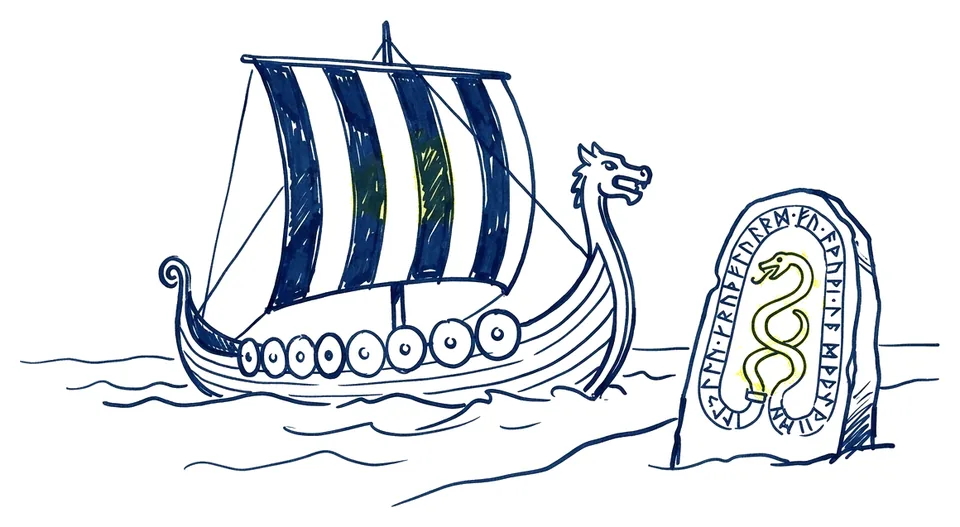
Vikingetiden varede fra ca. 750 til ca. 1050. Vikingerne sejlede på togter til bl.a. England, Irland, Frankrig og Rusland. I 1013 erobrede kong Svend Tveskæg England, og i ca. 30 år havde England danske konger, bl.a. Knud den Store. Før kristendommen troede danskerne på asernes guder, fx Odin, Thor og Freja. Kong Harald Blåtand blev døbt omkring 965. Han rejste Jellingestenen, som fortæller, at han samlede Danmark og gjorde danskerne kristne.
The Viking Age lasted from about 750 to about 1050. The Vikings sailed on raids (togter) to places such as England, Ireland, France and Russia. In 1013, King Sweyn Forkbeard (Svend Tveskæg) conquered England, and for about 30 years England had Danish kings, including Cnut the Great (Knud den Store). Before Christianity, the Danes believed in the Norse gods (the Æsir), for example Odin, Thor and Freja. King Harald Bluetooth (Harald Blåtand) was baptised around 965. He raised the Jelling Stone (Jellingestenen), which says that he united Denmark and made the Danes Christian.
I middelalderen (ca. 1050–1500) kæmpede kongen og stormændene om magten. Kirken blev rig, og omkring 1250 var der næsten 3.000 kirker i landet. Samfundet var delt i fire stænder: gejstlighed, adel, borgere og bønder. Omkring 1350 døde ca. hver tredje dansker af pest. Kalmarunionen fra 1397 samlede Danmark, Norge og Sverige, og Margrete 1. var den vigtigste person bag den. Ved reformationen i 1536 blev Danmark protestantisk, og kongen blev leder af kirken og overtog dens jord.
In the Middle Ages (about 1050–1500), the king and the magnates (stormænd) fought for power. The Church became rich, and around 1250 there were almost 3,000 churches in the country. Society was divided into four estates (stænder): the clergy, the nobility, the townspeople and the peasants. Around 1350, about one in three Danes died of plague. The Kalmar Union (Kalmarunionen) of 1397 united Denmark, Norway and Sweden, and Margaret I (Margrete 1.) was the most important person behind it. With the Reformation in 1536, Denmark became Protestant, and the king became head of the Church and took over its land.
I renæssancen var Danmark ofte i krig med Sverige. Christian 4. var konge i næsten 60 år og byggede bl.a. Rundetårn, Børsen og Rosenborg. I 1658 tabte Danmark Skåne, Halland og Blekinge. Efter nederlagene fik landet en ny styreform: I 1660 blev kongemagten arvelig, og i 1661 blev kongen enevældig. I 1788 blev stavnsbåndet afskaffet, så bønderne selv kunne vælge, hvor de ville bo og arbejde. Mange bønder fik deres egen gård.
During the Renaissance, Denmark was often at war with Sweden. Christian IV (Christian 4.) was king for almost 60 years and built Rundetårn (the Round Tower), Børsen (the Old Stock Exchange) and Rosenborg, among other buildings. In 1658, Denmark lost Skåne, Halland and Blekinge. After the defeats, the country got a new form of government: in 1660 the king's power became hereditary, and in 1661 the king became an absolute ruler (enevældig). In 1788, stavnsbåndet (the rule that tied peasants to an estate) was abolished, so the peasants could choose for themselves where they wanted to live and work. Many peasants got their own farm.
I 1848 opgav Frederik 7. enevælden, og den 5. juni 1849 fik Danmark sin første grundlov. Folket kunne nu vælge Rigsdagen, men kvinder, fattige og mænd under 30 år fik først stemmeret i 1915. I 1864 mistede Danmark Slesvig og Holsten. Fra 1840'erne kom der jernbaner, og efter 1870 kom der mange fabrikker og en ny arbejderklasse. Partier som Venstre, Socialdemokratiet og Det Radikale Venstre blev dannet.
In 1848, Frederick VII (Frederik 7.) gave up enevælden (absolute monarchy), and on 5 June 1849 Denmark got its first grundlov (constitution). The people could now elect the Rigsdag (parliament), but women, poor people and men under 30 did not get the right to vote until 1915. In 1864, Denmark lost Slesvig and Holsten (Schleswig and Holstein). Railways came from the 1840s, and after 1870 many factories appeared, along with a new working class. Parties such as Venstre, Socialdemokratiet (the Social Democrats) and Det Radikale Venstre (the Social Liberals) were founded.
Danmark holdt sig neutralt under 1. Verdenskrig. Den 9. april 1940 blev landet besat af Tyskland. Regeringen samarbejdede først med tyskerne, men i august 1943 stoppede samarbejdet på grund af modstand fra befolkningen. Den 5. maj 1945 blev Danmark officielt befriet af britiske soldater.
Denmark stayed neutral during the First World War. On 9 April 1940, the country was occupied by Germany. At first the government cooperated with the Germans, but in August 1943 the cooperation stopped because of resistance from the population. On 5 May 1945, Denmark was officially liberated by British soldiers.
Remember this
- Vikingetiden varede fra ca. 750 til ca. 1050. The Viking Age lasted from about 750 to about 1050. page 109
- Harald Blåtand rejste Jellingestenen, som kaldes Danmarks dåbsattest, fordi den fortæller, at han gjorde danskerne kristne. Harald Bluetooth (Harald Blåtand) raised the Jelling Stone (Jellingestenen), which is called Denmark's baptismal certificate (dåbsattest) because it says that he made the Danes Christian. page 108
- Margrete 1. stod bag Kalmarunionen, som i 1397 samlede Danmark, Norge og Sverige. Margaret I (Margrete 1.) was behind the Kalmar Union (Kalmarunionen), which united Denmark, Norway and Sweden in 1397. page 110
- Ved reformationen i 1536 blev Danmark protestantisk, og kongen blev kirkens overhoved. With the Reformation in 1536, Denmark became Protestant, and the king became head of the Church. page 110
- I 1658 måtte Danmark give Skåne, Halland og Blekinge til Sverige. In 1658, Denmark had to give Skåne, Halland and Blekinge to Sweden. page 111
- Enevælden begyndte i 1660–61 og sluttede i 1848. Enevælden (absolute monarchy) began in 1660–61 and ended in 1848. page 111
- Stavnsbåndet blev afskaffet i 1788, så bønderne selv kunne vælge, hvor de ville bo og arbejde. Stavnsbåndet (the rule that tied peasants to an estate) was abolished in 1788, so the peasants could choose for themselves where they wanted to live and work. page 111
- Danmarks første grundlov er fra den 5. juni 1849. Denmark's first grundlov (constitution) dates from 5 June 1849. page 112
- I 1864 mistede Danmark hertugdømmerne Slesvig og Holsten. In 1864, Denmark lost the duchies of Slesvig and Holsten (Schleswig and Holstein). page 113
- Tyskland besatte Danmark den 9. april 1940, og landet blev befriet den 5. maj 1945. Germany occupied Denmark on 9 April 1940, and the country was liberated on 5 May 1945. page 114
Words to know
- asatro Norse paganism
- Den gamle nordiske religion, hvor man troede på flere guder, fx Odin og Thor.The old Norse religion, in which people believed in several gods, for example Odin and Thor.
- dåbsattest baptismal certificate
- Et papir, der viser, at en person er blevet døbt.A document that shows that a person has been baptised.
- frugtbarhed fertility
- Evnen til at få børn eller unger. Frugtbar jord giver en god høst.The ability to have children or young animals. Fertile soil gives a good harvest.
- togt raid, expedition
- En rejse med skib for at plyndre, handle eller erobre land.A journey by ship to plunder, trade or conquer land.
- krigsbytte plunder, spoils of war
- Penge og ting, som man tager fra fjenden i en krig.Money and things that you take from the enemy in a war.
- stormand magnate, nobleman
- En rig og mægtig mand, som ejede meget jord.A rich and powerful man who owned a lot of land.
- stand estate (social class)
- En fast gruppe i samfundet, fx adel eller bønder. Man blev som regel født ind i den.A fixed group in society, for example the nobility or the peasants. You were usually born into it.
- reformationen the Reformation
- Bruddet med den katolske kirke i 1536, hvor Danmark blev protestantisk.The break with the Catholic Church in 1536, when Denmark became Protestant.
- valgkongedømme elective monarchy
- En styreform, hvor kongen bliver valgt, i stedet for at tronen går i arv.A form of government in which the king is elected, instead of the throne being inherited.
- enevælde absolute monarchy
- En styreform, hvor kongen har al magt alene.A form of government in which the king alone has all the power.
- stavnsbånd tie to the estate (serfdom-like bond)
- En regel, der bandt bonden til ét sted og én godsejer. Den blev afskaffet i 1788.A rule that tied the peasant to one place and one landowner. It was abolished in 1788.
- landboreformer agrarian reforms
- Nye love i slutningen af 1700-tallet, som gav bønderne mere frihed og ret til at eje deres egen jord.New laws at the end of the 18th century (the 1700s) that gave the peasants more freedom and the right to own their own land.
- hertugdømme duchy
- Et område, som en hertug styrer, fx Slesvig og Holsten.An area ruled by a duke, for example Slesvig and Holsten.
- husmand smallholder, cottager
- En fattig person på landet med et lille hus og meget lidt eller ingen jord.A poor person in the countryside with a small house and very little or no land.
- besættelse occupation
- Når soldater fra et fremmed land tager kontrol over et land.When soldiers from a foreign country take control of a country.
Read the fact sheet in the official study material (Danish) (page 107)